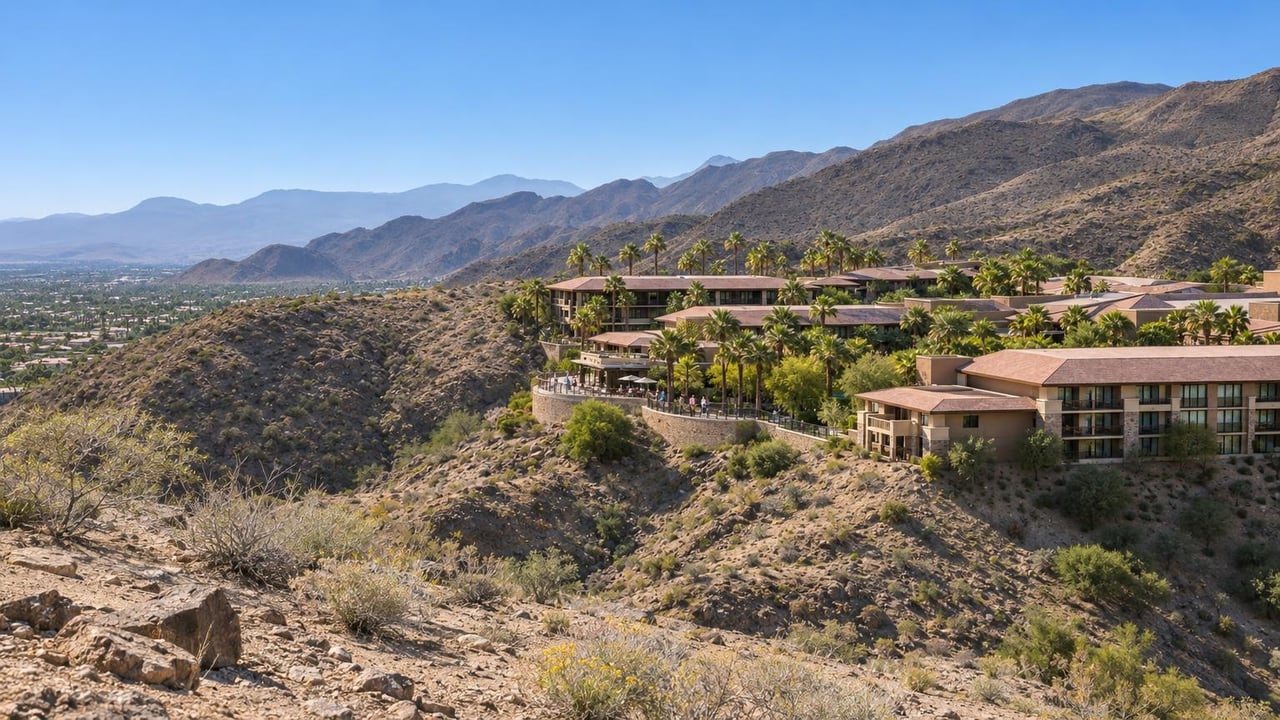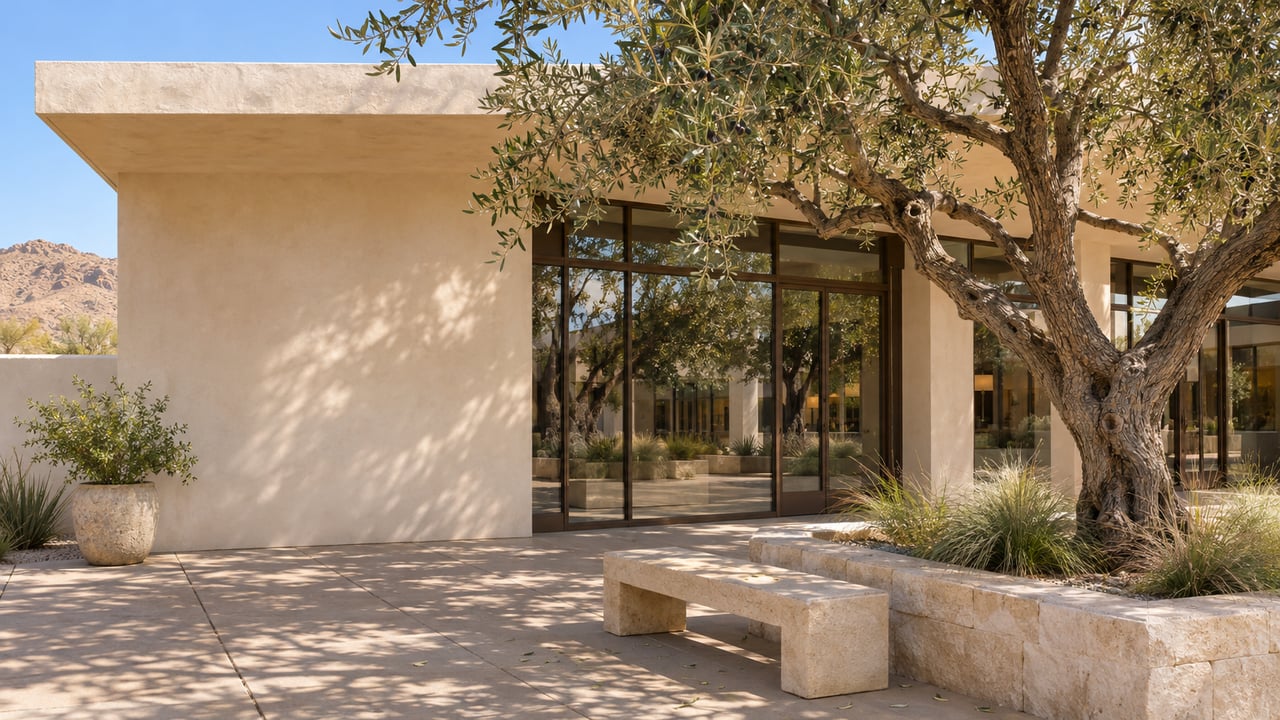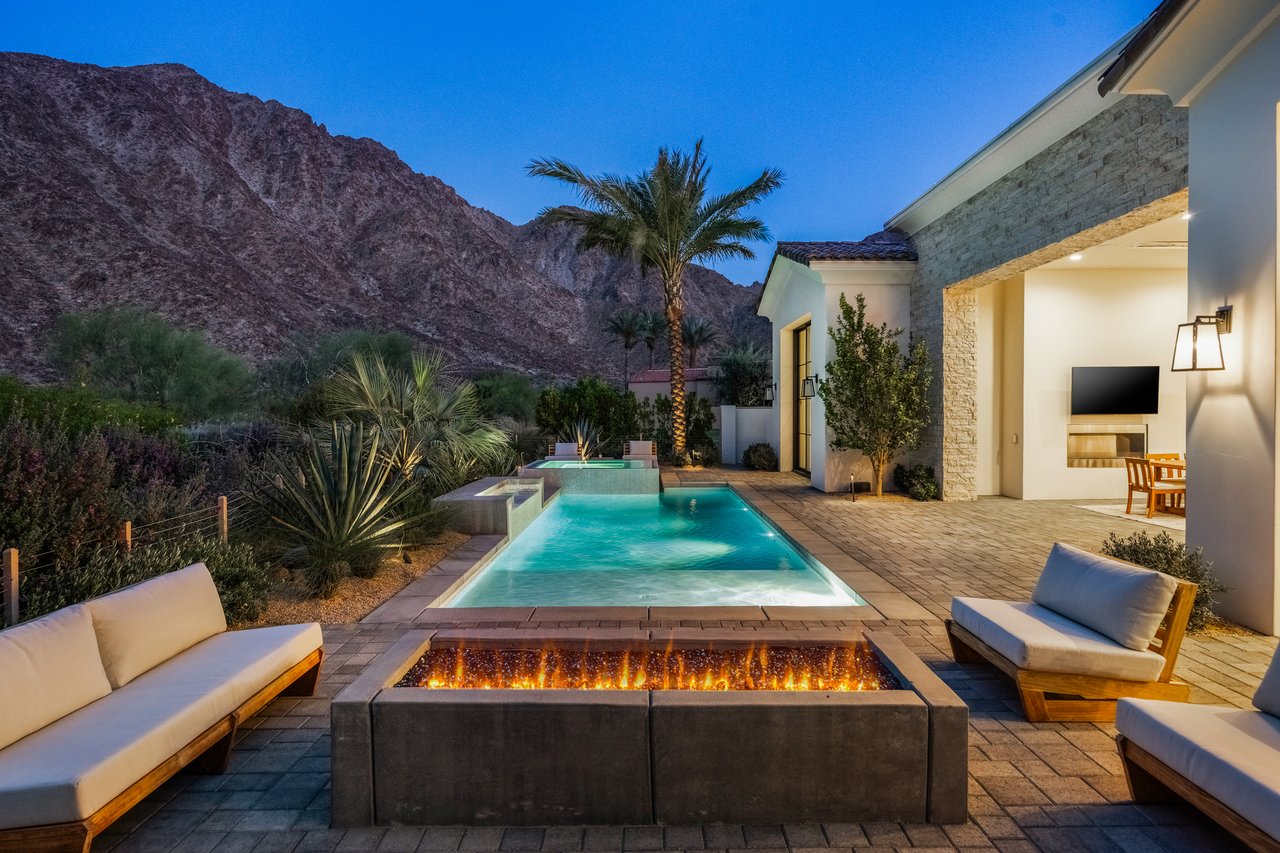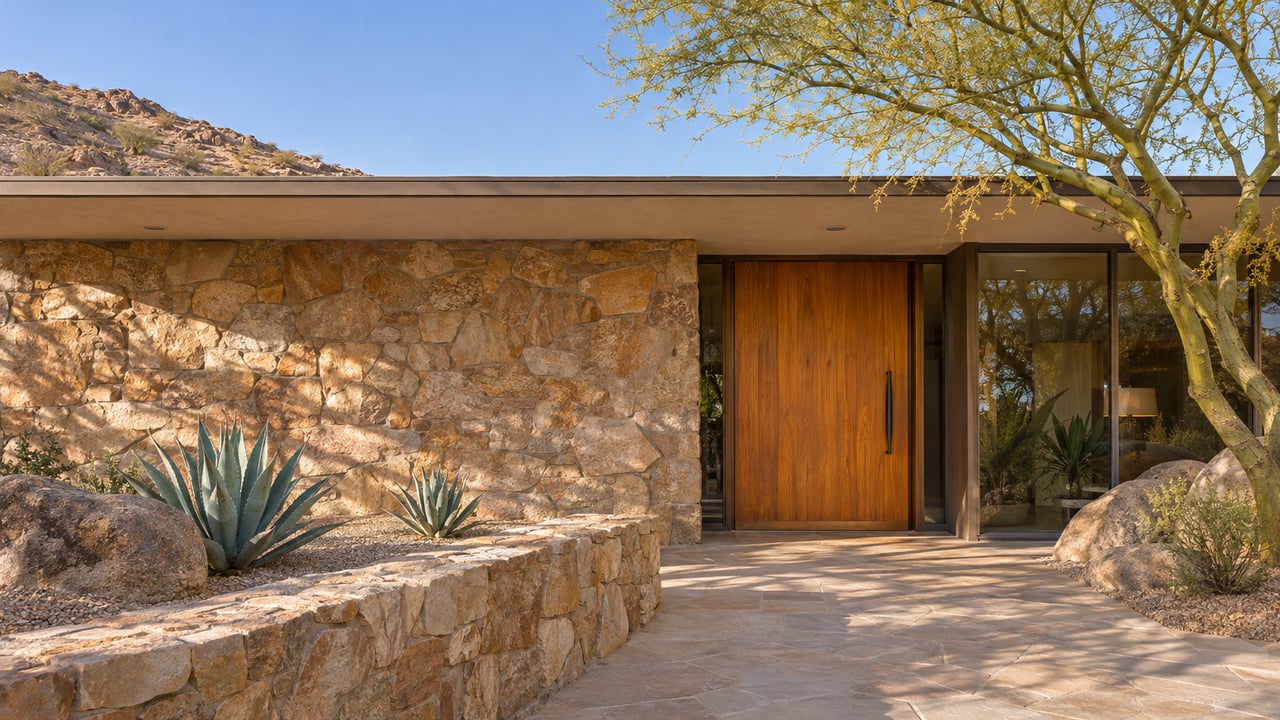
While Michael S. Smith was designing the visitor center at Sunnylands, he kept looking up at one house on the mountain. "I was constantly looking at this house up on the mountain, the highest-elevation home in Rancho Mirage," he told Architectural Digest in 2015. The house was Ichpa Mayapan, Howard Lapham's Mayan Revival villa in Thunderbird Heights. Smith and his partner, James Costos, bought it as a weekend retreat. Over two years they restored the exterior, and Smith redesigned interiors that the magazine described as dilapidated.
That pattern runs through the history of the whole hill. The named houses still standing in Thunderbird Heights mostly survived because one specific owner took them on. The houses nobody took on have disappeared one at a time, from the 1980s up to 2020. The neighborhood is small. Palm Springs Life counted 123 housing units in its 2025 neighborhood data, so each loss takes away a real share of the hill's architectural record.
1951 to 1954: The club fills up and the hill begins
According to the Los Angeles Times, Thunderbird Country Club opened in 1951 and was an instant hit. Buyers took the limited space inside the club, and latecomers moved up into the hills overlooking the course. Modernist retreats followed, on a gated hillside that came to be called Thunderbird Heights. The original name was Thunderbird Ranch Estates. Rancho Mirage didn't incorporate until 1973, so for its first two decades the whole area went by "Palm Springs."
One of the earliest houses on the hill was also one of the first to go. Preservation Mirage lists William F. Cody's Frank Belcher Residence in Thunderbird Heights as built in 1954 and lost in the 1980s. Cody was already busy at the club below. The Times reports that the club's investors hired him to design 14 more guest cottages while the course was under construction.
1957 and 1958: Crosby, White Shadows, and a house with no architect's name
Bing Crosby was an original investor in Thunderbird Country Club. Dwell reports that he passed on a golf course lot and was one of the first buyers in Thunderbird Ranch Estates, up on the hill. His 1957 house was a modest ranch with board-and-batten siding and floor-to-ceiling windows facing the valley, and its architect is unknown.
The same year, Henry Eggers and Walter Wilkman designed White Shadows at 70-378 Pecos Road for Thomas B. Davis. Dwell's account of the house describes Carrara marble running from the courtyard through the interior and out to the pool, and a central fountain inside covered walkways with arch motifs. The design was a collaboration with furniture designer and architect T.H. Robsjohn-Gibbings. The City of Rancho Mirage designated it a historic resource on March 3, 2016, and the city's Register of Historic Resources records it as built in 1957. Palm Springs Life reported in 2018 that the launch party for the book Mod Mirage was set for October 20 at White Shadows, one of the houses featured in it, during Modernism Week Fall Preview.
The Swan House went up a year later, in 1958. Its records were lost at some point after construction, and the architect is still unknown. As The Desert Sun reported in 2015, H3K Design bought the house out of foreclosure in 2012, and an appraiser told the buyers it wasn't worth saving. Howard Hawkes and Kevin Kemper turned down the full teardown that some people recommended. They replaced drywall, some framing and the roof, and kept the original U-shaped plan, with one arm slightly longer than the other. "I really think we saved this house," Hawkes told the paper. Swan House is the clearest case on the hill of a single owner's decision deciding whether a house survived.
1960 and 1961: Three architects, two losses
Thornton Ladd and John Kelsey designed the Tompkins Residence there in 1960. Cody came back in 1961 for the Nicoletti Residence. Preservation Mirage lists it as lost in the 1990s.
Lapham also built in 1961. He had come to the desert by the mid-1950s, and Palm Springs Life credits him with helping create Thunderbird Heights as development moved upslope east and southeast of the club. His houses had fortresslike street fronts, long, low volumes pinned to the terrain, massive stone walls and layered terraces. The hill lost one of his houses only six years ago. Preservation Mirage lists Lapham's 1961 Hyatt Von Dehn Residence in Thunderbird Heights as demolished in 2020.
That gives the hill one documented loss in each of the 1980s, the 1990s and 2020. All three were built between 1954 and 1961, in the hill's first years of building.
1970: Ichpa Mayapan goes up the mountain
Lapham kept building on the hill after the 1960s. In 1970 he pushed his fortress style into Mayan Revival with Ichpa Mayapan, the house from the opening. Palm Springs Life describes its temple-like geometry, stepped massing and heavy stonework, and says the name refers to Maya terms for fortified cities. Architectural Digest describes the house as 11,000 square feet, with a hand-carved Mayan calendar in the entrance court and a keystone-shaped pool watched over by a huge Mayan-inspired stone figure. The house looks down on the valley floor and across to Sunnylands.
The first owner was Maxine Cook. Smith called her "a scratch golfer and very prominent on the Thunderbird Country Club links," and said her neighbors included Bing Crosby and Betty and Gerald Ford. The Times places the Fords' house on the club's 13th fairway, down below the Heights. The Times also reports that Barack Obama has visited the area often enough to start rumors that he was thinking of moving to the Heights.
1980: Wexler arrives late
Donald Wexler is best known for his work in the 1950s and 1960s, but his house in Thunderbird Heights dates from 1980. In 2021, Palm Springs Life profiled a 1980 Wexler house in the Heights built for Herman Kassinger. Kassinger was a Canadian homebuilder who developed upscale communities in Palm Springs starting in 1978 and built the Bank of Palm Springs Shopping Centre downtown. The magazine placed the house on one of the highest streets in the neighborhood, on a 0.60-acre lot, with steel and glass and overhangs on Wexler's "spider leg" posts. The city's register lists a 1980 Wexler house at 70-170 Sonora Road, designated on September 17, 2015.
Wexler's house brings the timeline on the hill to almost three decades, from Cody's Belcher house in 1954 to a steel-and-glass house in 1980. The two houses on the city register stand at either end of that span: White Shadows from 1957 and the Wexler house from 1980.
Reading the ledger from your own street
The two Cody houses and the 1961 Lapham house went down in three different decades. White Shadows and the Sonora Road house have city designations, granted in 2015 and 2016. Swan House and Ichpa Mayapan are standing because buyers chose restoration when demolition was an option. In 2012, the year Swan House sold out of foreclosure, an appraiser called it a teardown.
Two public records let you follow this yourself. The City of Rancho Mirage's Register of Historic Resources lists each designated house with its year built, architect and designation date, and the city added another entry, a 1958 William Cody design on Country Club Drive, on June 18, 2026. Preservation Mirage keeps a Lost Architecture page that lists demolished Rancho Mirage houses by architect, neighborhood, year built and year lost. The Thunderbird Heights entries are a short list. If you want to research the house you live in, our guide to evaluating architectural provenance in Thunderbird Heights walks through documentary records and on-site clues. Our Thunderbird Heights neighborhood page has more on the hill as it is today.
If you own one of these houses, or one whose architect is still unknown like the Swan House, you're a big part of what decides how the next chapter of its story goes. Rich Nolan represents architecturally significant homes across the Coachella Valley with marketing built around who designed the house and when. Schedule a design-first marketing consultation and we'll begin with your house's history.